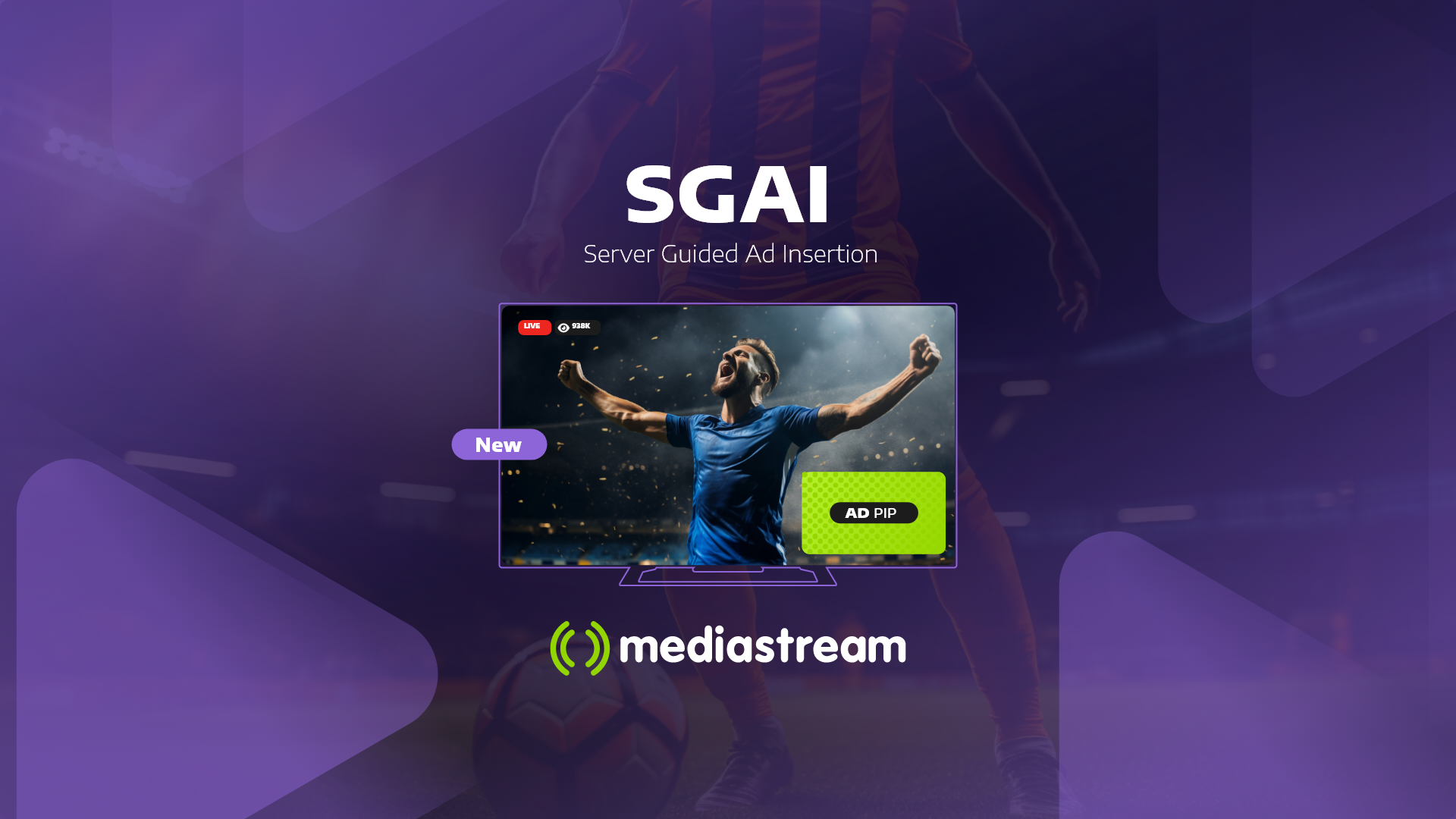
Seventieth minute, corner kick. Nobody gets up from the couch. During an ad break, that same viewer would have walked to the kitchen. Instead, the match shrinks, an L-shaped banner wraps around it, and the ad shares the screen with the play without cutting it off.
That format is one of the examples Felipe del Castillo, Strategic Partnerships Manager at Google, gave in the conversation we recorded with him at our Bogotá office. Felipe has spent 11 years at Google and has worked with Mediastream for years. Across the table was Luis Ahumada, CEO of Mediastream. For an hour they talked about how Latin American media companies can get more value out of their content. These are the ideas that stayed with us.
Felipe sees a clear opportunity for media companies in Connected TV, with a caveat: it isn't one market. TV sets run on more than seven different ecosystems, while mobile is mostly Android or iOS. There are two ways in. The fastest is to join something that already works, like a FAST channel on Samsung TV Plus: no app to build and an audience already in place, in exchange for lower margins and less control. The other is to build your own apps for each platform.
On formats, the strongest today is replacing the ad break through dynamic ad insertion. What comes next are non-interruptive formats: an L-banner or a side-by-side ad at a key moment. They can be scheduled for a given minute of the match, triggered by a yellow card, or timed to the moment a reality show reveals its vote. The content owner even decides which of the two pictures keeps the audio.
Why do they earn more? Attention: the viewer is watching, not taking a break. Felipe says that in direct deals he sees these formats command CPMs 50% to 70% above an ad break. He gives three reasons why Connected TV in general sells better: a bigger screen, sound (on social, ads usually play muted while people scroll) and personalization.
The open auction almost runs itself: you set it up, define floor prices and let it go. But buyers pay for what they know. Felipe sorts the signals into three groups:
There is one more, automatic but switched off by default: passing the user's full IP address, which tells buyers they're dealing with a real person (buyers never see that IP). According to Felipe, it has lifted CPMs by 15% to 20% in the cases he has seen.
Why now? Because Safari and iOS already block third-party cookies, so first-party data is no longer a someday project. Felipe sums it up: the more data a publisher passes, the more it can raise prices and earn the same revenue with fewer impressions.
The best example of someone who started putting their data to work, Felipe said, isn't a media company. It's Uber. After you request a ride, you stare at the screen until the car shows up. Uber turned that wait into a video placement that doesn't get in anyone's way, and sells it knowing where the rider is headed.
Felipe frames it as the third wave of digital advertising: first search, then social, and now commerce media. Amazon, Mercado Libre and Uber all sell advertising, much of it video, backed by what they know about their users. Mercado Libre, for example, launched a free, ad-supported video platform to get value out of that data. They are new competitors for the same budgets, and they show up with data.
For a media company the lesson is twofold: find your own waiting moments (Felipe points to the interstitial that loads between one article and the next) and protect the experience. His advice for the web, and hopefully for Connected TV: let new users fall for the content first, and show them ads later.
The most forward-looking part of the conversation is agent-to-agent buying. Programmatic direct still needs someone to negotiate and set up every deal. Felipe describes what's coming: the publisher builds inventory packages in Google Ad Manager (formats, viewability and CPM for 30 days, say) and lists them in a marketplace. On the advertiser side, agents with a goal and a budget read what's on offer and put the media plan together. The publisher approves according to the rules it has set.
Felipe mentioned that Google announced in New York, a few weeks before the conversation, a Google Ad Manager MCP: the way for AI platforms not only to read what's in Ad Manager but to take action in it. For example, asking an assistant to build and list an inventory package for a tournament that starts the following week.
That brings data back to the center. An agent with instructions won't buy inventory if it doesn't know who it reaches. In Felipe's words, there is finally a reason why a publisher has to have data, no exceptions: without it, nobody may buy from you. The budget will go to whoever has it.
Felipe closed with something we see every day: these technologies aren't simple to implement, and media companies in the region move faster when someone walks the road with them. Luis put it from Mediastream's side: if content doesn't come with monetization and an audience, there's nothing to distribute.
The episode has more: the "proof of posting" screenshot some advertisers still ask for, the formats TV manufacturers are adding to the home screen and menus, and an idea that still sounds like the future, ads generated in real time on the TV set itself.
Watch the Mediastream Connecting episode with Felipe del Castillo (Google)